
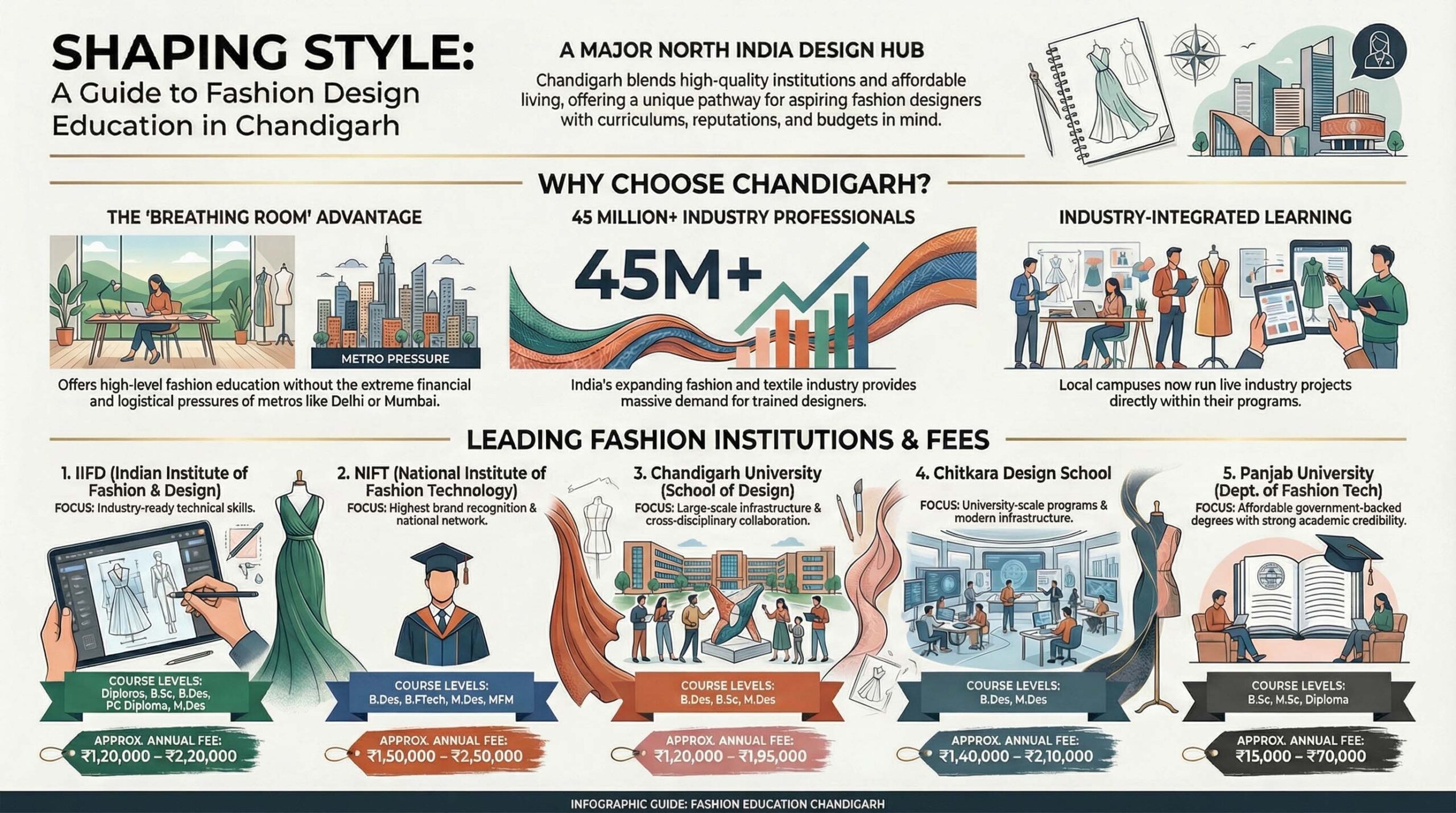
Chandigarh has earned a real reputation as a design education hub in North India. Students from across Punjab, Haryana, Himachal Pradesh, and Uttarakhand now seriously consider Chandigarh before looking at Mumbai or Delhi. The city combines quality institutions, affordable living, a growing creative industry, and strong internship pipelines — all in one place.
If you want to study fashion designing and want honest information about where to go, what courses exist, and what fees look like, this guide gives you exactly that.
Why Chandigarh Works for Fashion Design Students
India’s fashion and textile industry now employs over 45 million people directly. Demand for trained designers continues rising as domestic retail brands expand, export houses scale up, and direct-to-consumer fashion labels multiply across e-commerce platforms.
Chandigarh offers students something the metros often cannot — breathing room. You get serious education without the financial pressure of Mumbai or Delhi. Campus infrastructure across the city has improved sharply over the last five years, and several institutions now run live industry projects inside their programs rather than treating industry exposure as an afterthought.
1. IIFD – Indian Institute of Fashion and Design, Chandigarh
IIFD holds a well-earned position as one of the most respected fashion designing colleges in Chandigarh. The institute does not just talk about industry connection — it builds it into the daily structure of its programs.
Courses Offered at IIFD
IIFD runs programs across diploma, graduation, and postgraduation levels, making it one of the few institutions in the city that covers every stage of design education.
- Diploma in Fashion Designing (1–2 years)
- B.Sc. in Fashion Designing (3 years)
- B.Des in Fashion Design (4 years)
- Postgraduate Diploma in Fashion Design and Management (1–2 years)
- M.Des in Fashion Design (2 years)
The institute also runs fashion styling, textile design, and accessory design programs alongside its core fashion courses in Chandigarh, giving students room to specialize based on their interests.
What the Curriculum Actually Covers
Students at IIFD learn garment construction, pattern making, draping, fabric science, fashion illustration, trend forecasting, CAD for fashion, portfolio building, and brand management. The program does not separate theory from studio work — both run together throughout every year.
Faculty members practice professionally in the design industry, which keeps instruction grounded in what employers currently want rather than what worked a decade ago.
Fee Structure
| Program | Approximate Annual Fee |
|---|---|
| Diploma in Fashion Designing | ₹120,000 – ₹1,40,000 |
| B.Sc. / B.Des in Fashion Design | ₹1,50,000 – ₹1,90,000 |
| PG Diploma / M.Des | ₹1,70,000 – ₹2,20,000 |
Fees vary by batch and specialization. Contact the IIFD admissions team directly for current figures before applying.
Why Students Pick IIFD
As a full-service design institute in Chandigarh, IIFD connects students to brands, export houses, design studios, and fashion media through its placement support. Graduates from diploma programs find entry-level roles quickly. Degree and postgraduate alumni move into design, merchandising, styling, and brand management positions across North India and beyond.
2. NIFT – National Institute of Fashion Technology
NIFT Chandigarh carries India’s most recognized fashion education brand. Admission runs through the NIFT Entrance Exam, which tests creative aptitude, situation response, and general ability. Students who clear it gain access to a curriculum and alumni network that opens doors at major Indian and international fashion companies.
Courses Offered
Undergraduate Programs:
- B.Des – Fashion Design, Textile Design, Fashion Communication, Accessory Design
- B.FTech – Apparel Production
Postgraduate Programs:
- M.Des, M.FTech, MFM (Master of Fashion Management)
Fee Structure
| Program | Approximate Annual Fee |
|---|---|
| B.Des / B.FTech | ₹1,80,000 – ₹2,20,000 |
| M.Des / MFM | ₹1,50,000 – ₹2,50,000 |
Hostel and examination fees apply separately. Government fee concessions exist for reserved category students.
What Makes NIFT Worth the Effort
The brand recognition alone differentiates NIFT graduates in the job market. Retailers, export houses, and fashion media companies actively recruit from NIFT campuses. The national network of alumni also gives graduates professional connections across every major Indian city from day one of their career.
3. Chandigarh University – School of Design
Chandigarh University has invested heavily in its design school over the last four years. The fashion design program now draws serious applicants who want university-level credentials paired with strong placement infrastructure and a large, well-equipped campus.
Courses Offered
Undergraduate:
- B.Des in Fashion Design
- B.Sc. in Fashion Designing
Postgraduate:
- M.Des in Fashion Design
Fee Structure
| Program | Approximate Annual Fee |
|---|---|
| B.Des / B.Sc. | ₹1,20,000 – ₹1,60,000 |
| M.Des | ₹1,70,000 – ₹1,95,000 |
What the Program Delivers
Students cover fashion illustration, pattern drafting, garment technology, textile studies, digital design tools, and fashion merchandising. The university’s scale means students get access to textile labs, CAD facilities, and a large placement cell that actively contacts hiring companies throughout the year. Students who want a full university campus experience alongside quality fashion courses in Chandigarh find Chandigarh University a practical and strong choice.
4. Chitkara Design School, Chitkara University
Chitkara Design School has steadily built a strong identity within the Chandigarh-Panchkula-Rajpura belt. The school runs under Chitkara University and offers a design curriculum that blends creative education with technology, entrepreneurship, and professional practice. Students who want university infrastructure alongside a focused design program find Chitkara a compelling option.
Courses Offered
Undergraduate:
- B.Des in Fashion Design
- B.Des in Communication Design
- B.Des in Interior Design
Postgraduate:
- M.Des in Fashion Design
- M.Des in Communication Design
Fee Structure
| Program | Approximate Annual Fee |
|---|---|
| B.Des Programs | ₹1,40,000 – ₹2,00,000 |
| M.Des Programs | ₹1,70,000 – ₹2,10,000 |
Fee figures are approximate. Chitkara University revises its fee structure annually, so direct verification with the admissions office gives the most accurate numbers.
What Chitkara Design School Delivers
The curriculum covers fashion illustration, garment technology, surface design, digital tools, trend research, and collection development. Chitkara’s university ecosystem means students get access to entrepreneurship cells, incubation support, and cross-disciplinary collaboration with students from engineering, business, and media programs. Several Chitkara Design School graduates have launched independent fashion labels within two years of completing their degrees. The school also runs regular masterclasses and design workshops with industry professionals, keeping students connected to what the fashion market actually demands.
5. Panjab University – Department of Fashion Technology, Chandigarh
Panjab University carries over a century of academic credibility, and its Department of Fashion Technology brings that weight directly into design education. For students who want a government university degree with strong academic grounding alongside practical fashion training, Panjab University delivers a combination that few private institutions can replicate.
Courses Offered
Undergraduate:
- B.Sc. in Fashion Technology (3 years)
- B.Sc. in Textile Design (3 years)
Postgraduate:
- M.Sc. in Fashion Technology (2 years)
- M.Sc. in Textile Design (2 years)
Diploma:
- Diploma in Dress Designing and Garment Construction
Fee Structure
| Program | Approximate Annual Fee |
|---|---|
| B.Sc. Programs | ₹25,000 – ₹60,000 |
| M.Sc. Programs | ₹30,000 – ₹70,000 |
| Diploma Programs | ₹15,000 – ₹30,000 |
Panjab University fees sit significantly lower than private institutions, making it the most affordable serious option for fashion education in the Chandigarh region.
Why Panjab University Deserves Serious Attention
Students often overlook Panjab University because private institutions spend more on marketing. That oversight costs many students a genuinely strong opportunity. The department covers textile science, garment construction, pattern technology, fashion history, apparel production management, and quality control with academic depth that goes beyond what most private diploma programs offer.
The government university tag also matters for students who plan to pursue competitive examinations, teaching positions, or postgraduate research later in their careers. A Panjab University degree carries institutional credibility that remains solid across decades. Students who want affordable fashion courses in Chandigarh without compromising on academic quality consistently find Panjab University their best option.
Diploma, Degree, or Postgraduate — Which One Do You Actually Need?
This question matters more than most students realize when they first start researching fashion designing colleges in Chandigarh.
A diploma suits students who want to enter the workforce fast. One to two years of focused practical training builds the skills needed for entry-level roles in garment production, fashion retail, and styling.
A degree gives you broader knowledge, stronger long-term positioning, and eligibility for postgraduate study later. Most senior design, merchandising, and brand management roles require degree-level qualifications. Students with clear long-term career goals almost always benefit more from a degree than a diploma.
A postgraduate qualification makes the most sense for working professionals who want to specialize, move into academic roles, or pursue leadership positions in fashion business and design strategy. IIFD and NIFT both offer postgraduate programs that carry real weight in the industry.
What to Verify Before You Pay Any Fees
Choosing a fashion designing college is a financial and professional commitment. Before signing any enrollment form, check these things directly with the institution.
Active faculty — Ask whether instructors currently work in the fashion industry or only teach. Practitioners bring current knowledge that textbooks cannot replicate.
Software coverage — Adobe Illustrator, Photoshop, and CLO 3D now qualify as basic professional tools in fashion. Any serious program covers all three with adequate lab access.
Real placement data — Ask for specific company names where recent batches landed internships and jobs, not just logos on a brochure wall.
Physical infrastructure — Visit the campus. Walk through the sewing labs, textile studios, and CAD facilities before committing. A campus visit tells you more than any open day presentation.
Affiliations and recognition — Confirm that the degree or diploma connects to a recognized university or regulatory body. This matters significantly if you plan to pursue higher education after completing the program.
Make Your Decision Based on Facts, Not Marketing
Chandigarh gives fashion design students more genuine choices than most cities outside Mumbai, Delhi, and Bangalore. IIFD, NIFT, Chandigarh University, Chitkara Design School and Panjab University collectively cover every level of study, every budget range, and every career timeline. Research each program carefully, visit campuses in person, speak to current students, and apply to the institution that genuinely fits your goals — not the one with the loudest advertising.

Leave a Reply